
Critical text on the work of Francesco De Grandi
Critical Text on the Work of Francesco De Grandi
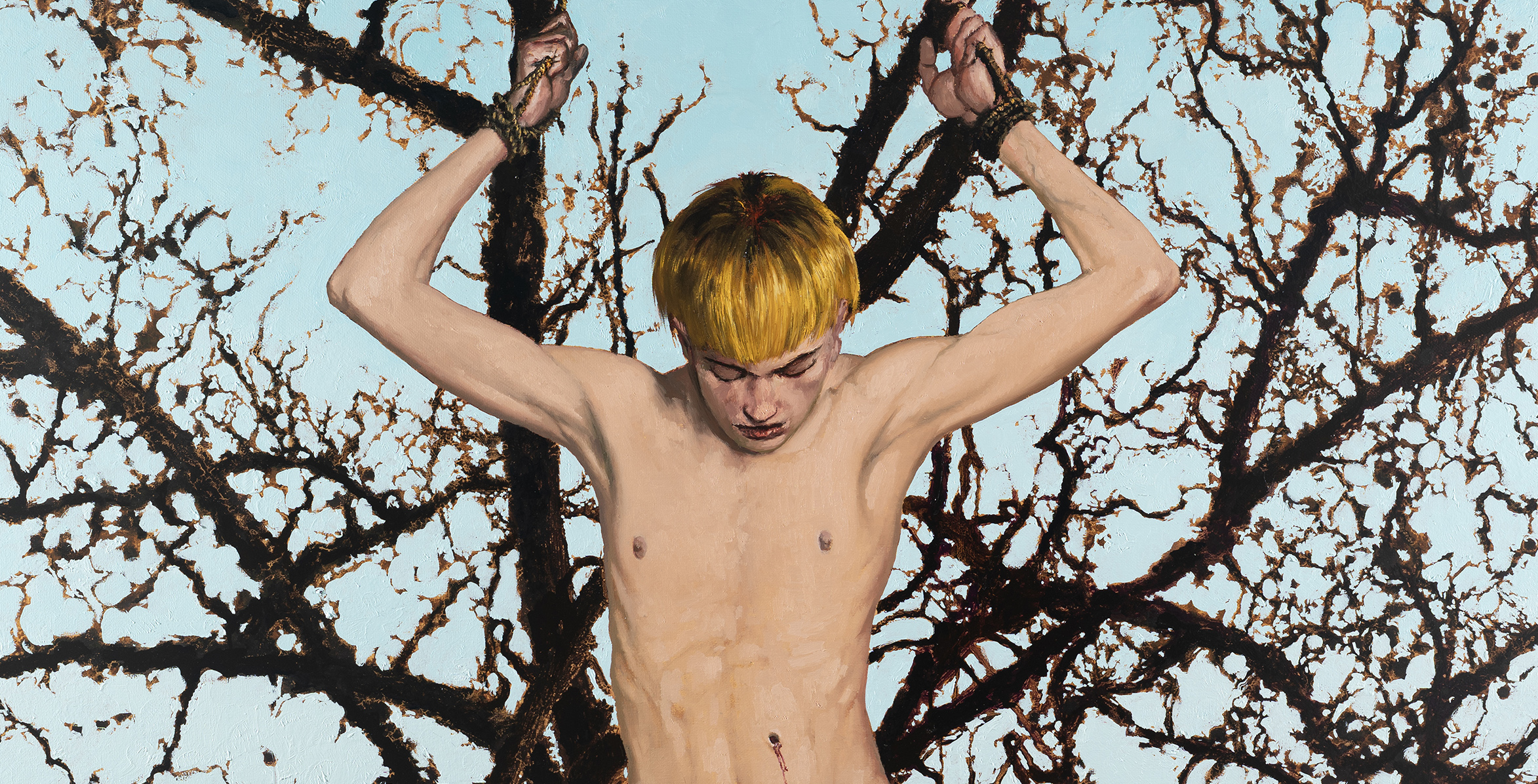
The painting of Francesco De Grandi takes shape as a territory of passage, a field of forces in which art history, myth, current events, and inner experience collide without ever resolving into a pacified synthesis. Each of his paintings seems to emerge from a hand-to-hand struggle with painting itself: not as an exercise in style, but as a necessary, almost obsessive practice, carried out along the subtle threshold between seduction and risk, between attraction and the abyss. For De Grandi, painting is not a neutral expressive act, but a gesture that entails exposure, vulnerability, and a form of secret transgression.
His imagery draws upon the founding archetypes of the Western tradition—the sacred, sacrifice, death, dance, procession, martyrdom—not to quote them, but to reactivate them as symbolic devices that remain fully operative. Painting thus becomes a site of knowledge, a practice that borders on meditation and embraces art history as a living, permeable language, continually shaken by contemporary tremors. Within this intense dialogue with tradition, De Grandi demonstrates a mature awareness of the pictorial medium: figuration is never illustrative, but charged with narrative, emotional, and spiritual tension.
His scenes often appear as collective theatres, inhabited by figures suspended between different epochs and registers. Myth coexists with reportage, the sacred with the profane, ecstatic vision with the brutality of the real. This coexistence does not produce harmony, but friction: bodies dance, struggle, writhe, as if traversed by a force that exceeds them. It is a painting that does not describe the world, but stages its drama, revealing the fragility of the human condition and the persistence of ancestral images that continue to operate beneath the surface of the present.
The artist’s biographical path—between Palermo, Milan, Shanghai, and the return to Sicily—is not secondary to this vision. Palermo, in particular, emerges as both a symbolic and real place in which historical stratification, ritual dimension, and a sense of the tragic find a natural resonance with his research. Here, De Grandi’s painting seems to find fertile ground to continue questioning the relationship between light and darkness, weakness and revelation, fall and the possibility of redemption.
Contemporaneity and Revolutionary Character
In my view, the contemporaneity of Francesco De Grandi lies in a radical and counter-current choice: to use figurative painting not as a nostalgic refuge, but as a critical instrument capable of confronting the present with a depth that many current practices deliberately avoid. In an art system often dominated by speed, surface, and hyper-conceptualization, De Grandi reclaims the long duration of painting, its symbolic weight, and its capacity to hold complexity.
The revolutionary nature of his work does not reside in formal innovation for its own sake, but in the act of reactivating ancient images to speak about today, revealing how our time is still inhabited by archaic drives: violence, desire, sacrality, fear of death, and the need for meaning. In this sense, his painting is profoundly contemporary because it rejects the illusion of the “new” as an automatic value and instead embraces critical continuity, stratification, and the ethical responsibility of the image.
De Grandi does not simplify reality or make it easily consumable. On the contrary, he exposes it in its ambiguity, forcing the viewer into an active, almost uncomfortable confrontation. It is precisely here that his painting becomes truly political and urgent: not through declared themes, but through its ability to generate thought, unease, and a form of awareness that passes through the sensory and symbolic experience of the image.
Francesco De Grandi Statement
Francesco De Grandi finds in the archetypal motives of art history a path of knowledge and a route toward spiritual elevation — a form of painting that verges on meditation. Narrative, figurative, romantic, evocative: De Grandi’s painting, suspended between the study of nature and the feeling of the sacred, reveals a mature awareness of painting as a language in constant dialogue with tradition, yet one that remains permeable to contemporary tremors — culminating in an iconographic reinterpretation where everything merges, and at times overturns.
His work is an homage to the immense human stage — the collective theatre that, from mythological tales to the raw chronicles of the present, populates the world’s proscenium.
A graduate of the Academy of Fine Arts in Palermo, De Grandi moved to Milan in 1994, where he lived until 2008. From 2009 to 2012 he worked in Shanghai, before returning to Palermo — a place more suited to the continuation of his research.
Since 1992, he has taken part in numerous solo and group exhibitions in public institutions, museums, and private galleries in Italy and abroad. Since 2015, he has been represented by RizzutoGallery. He lives and works in Palermo, where he also teaches Painting at the Academy of Fine Arts.
Selected Solo Exhibitions
Il sacrificio del miele, Galleria Civica di Trento; Narrativa, RizzutoGallery, Palermo; Nella debolezza, dalle tenebre alla luce – Crocifissione di Urbino, Church of San Francesco, Urbino, 2023. Vago Fiore, Ex Chiesa degli Almadiani, Viterbo, 2020; Aurea Hora, Fondazione Sicilia, Pinacoteca di Villa Zito, Palermo, 2019; Come Creatura, RizzutoGallery, Manifesta 12 Collateral Event, Palermo, 2018; Fragmente des Unbekennten, Gartenpavillon Malkasten, Düsseldorf, 2016; Archetipi della pittura inquieta, Convento del Carmine, Marsala, 2014; Il Passaggio Difficile, Galleria d’Arte Moderna, Palermo, 2011.
Selected Group Exhibitions
Giovanni Bellini. Il Compianto – Four contemporary artists in dialogue with a masterpiece, Museo Diocesano Carlo Maria Martini, Milan, 2024; Pittura italiana oggi, Triennale di Milano; Artificialia et Mirabilia, Villa d’Este, Tivoli; Medea, Antico Mercato di Siracusa, 2023; Camera Picta, Galleria Civica, Castello del Buonconsiglio, Mart, Trento, 2021; Foresta Urbana, Museo Riso, Palermo, 2019; La Scuola di Palermo, Museo Riso, Palermo, 2018; 54th Venice Biennale, Italian Pavilion, Corderie dell’Arsenale, Venice.
Public and Private Collections
His works are held in numerous public and private collections, among them: Palazzo Riso, Museo Regionale d’Arte Moderna e Contemporanea, Palermo; Collezione Farnesina Experimenta, Ministry of Foreign Affairs, Palazzo della Farnesina, Rome; Villa Adriana e Villa d’Este Museums, Tivoli; HangART7, Red Bull Hangar Collection, Salzburg, Austria; Museo Civico, Marsala; Museo Civico di Castelbuono; Museo del Novecento, Milan; Galleria d’Arte Moderna, Palermo; and the Museo d’Arte Moderna e Contemporanea della Repubblica di San Marino.